In this article
- What stays on a file after a treatment?
- Why isn’t shaking the dust off an ordinary file enough?
- Cleaning, disinfection and sterilisation: what is the difference?
- Does every nail file need to be thrown away?
- What if the file is kept just for me?
- Is a new file sterile?
- Is a single-use file enough to make a treatment safe?
- What happens during an appointment with me?
You sit down at the table, choose a colour and get ready to enjoy a little time for yourself. Your nail technician reaches for a file. A small item that, at first glance, might not seem particularly important.
You might think: “It’s only used on nails. If it looks clean, why can’t it be used again?”
That is an understandable question. Appearance alone, however, does not tell us whether a tool is suitable for reuse. Its material, intended use and whether it can be properly prepared for the next treatment all matter.
What stays on a file after a treatment?
During filing, dust from the natural nail plate and the product being removed collects on the file. The file may also come into contact with the skin around the nail.
This does not mean that every used file is a source of infection. It does mean that, after a treatment, we cannot regard it in the same way as before its first use.
Microorganisms cannot be seen with the naked eye. A file may look tidy and still need replacing or appropriate preparation, if it is a tool designed to be reused.
The absence of visible dirt does not confirm that something is safe. This is why hygiene procedures apply to every client, not only when something looks suspicious.
Why isn’t shaking the dust off an ordinary file enough?
A typical abrasive nail file does not have the same surface as a smooth metal tool. Small particles can remain between the abrasive grains, and its construction often includes layers of paper, foam and adhesive.
Tapping off the dust removes some of it, but it is not disinfection. Simply wiping the file or briefly spraying it with a product does not make a single-use file ready for another treatment either.
A disinfectant does not turn a single-use item into a reusable tool. The fact that a file still works well and has not fallen apart after contact with a liquid does not demonstrate that this approach is effective.
Cleaning, disinfection and sterilisation: what is the difference?
These terms are sometimes used interchangeably, although they describe different processes.
Cleaning removes dirt, such as dust or product residue. It is an important stage in preparing a tool, but it does not, by itself, mean that the tool has been disinfected.
Disinfection destroys or inactivates microorganisms within the stated scope of the method and product used. Factors such as the correct concentration, contact time and prior cleaning of the surface matter. It is not the same as sterilisation.
Sterilisation is a process that destroys all forms of microorganisms, including bacterial spores. It requires suitable equipment, an appropriate procedure and tools that can withstand that process.
“Sprayed”, “disinfected” and “sterile” therefore do not mean the same thing. They provide different information about how an item has been prepared.
Does every nail file need to be thrown away?
Not all files are made in the same way.
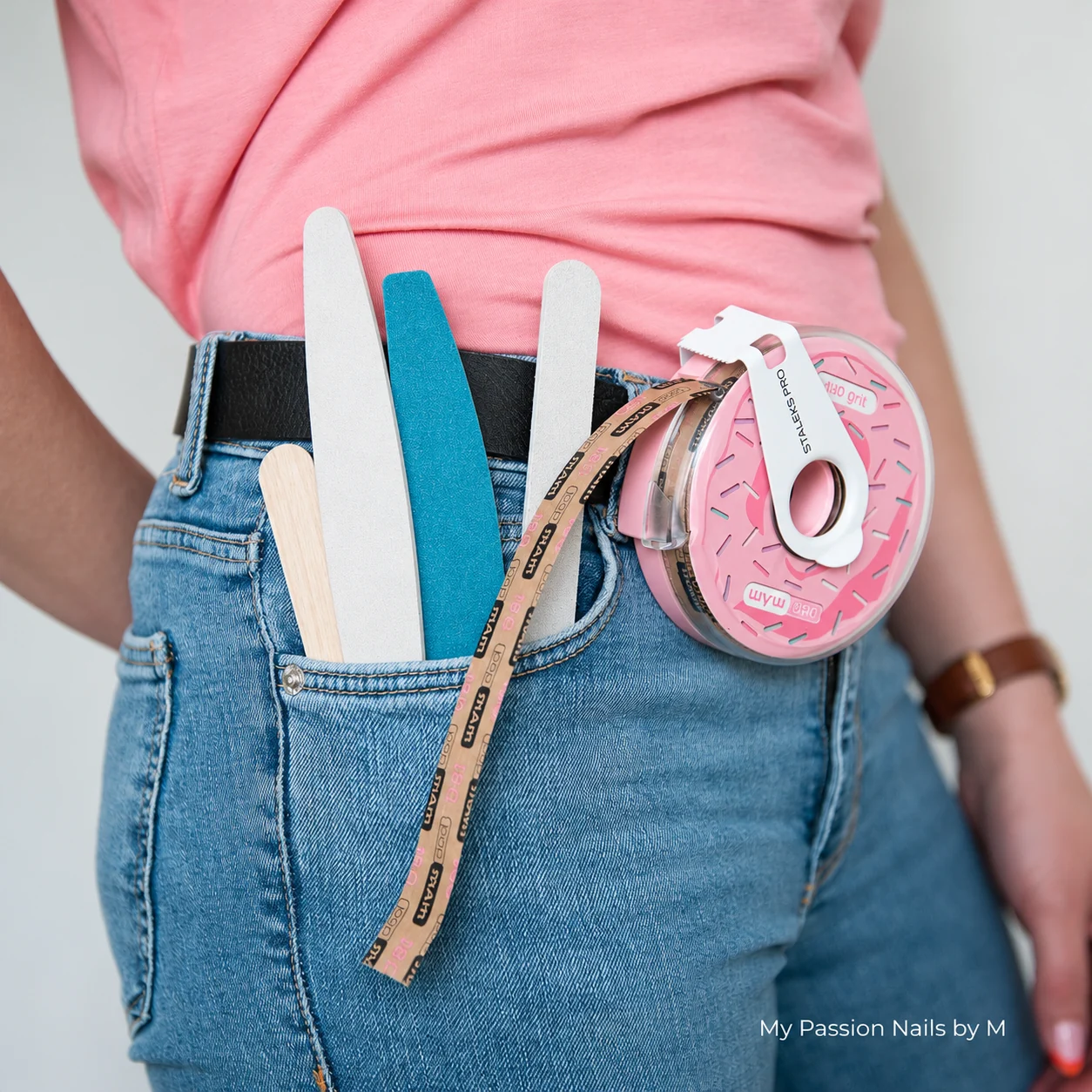
Alongside single-use abrasive files, there are reusable tools, such as certain metal or glass files. Whether they can be reused depends on their construction, intended use and the manufacturer’s instructions. How they are used and their contact with skin must also be taken into account.
It is important to distinguish between a single-use tool and a reusable one. Each requires appropriate handling.
The procedures for one type of tool should not be applied to all the others simply because we call them all nail files.
What if the file is kept just for me?
A personal envelope with your name on it may seem like a good solution. After all, that file is not being used on anyone else.
However, reserving a file for one client does not change its intended use. If it is a single-use item, a labelled envelope does not make it reusable.
For tools that are suitable for reuse, separate storage does not replace the required cleaning and further preparation either.
What matters most is therefore not whether your name is on the packaging, but whether the handling is appropriate for that type of tool.
Is a new file sterile?
Not automatically. “New” and “sterile” tell us two different things.
A new file has not been used before. Sterility means that a product has undergone an appropriate process and is supplied and stored in conditions that maintain that state.
An ordinary bag or retail packaging is not, by itself, proof of sterility. New supplies also need to be protected from contamination before work begins.
Single use therefore matters, but it does not replace proper storage or hygiene at the workstation.
Is a single-use file enough to make a treatment safe?
It is an important part, but not the only one.
Hand hygiene, preparation of the work surface, handling of other tools and the way the treatment is carried out all matter too. A new file cannot replace these steps.
Similarly, wearing gloves does not keep everything we touch clean. If gloves come into contact with a contaminated surface, they can carry contaminants elsewhere.
Hygiene involves the whole way of working, not one item shown before the manicure begins.
What happens during an appointment with me?
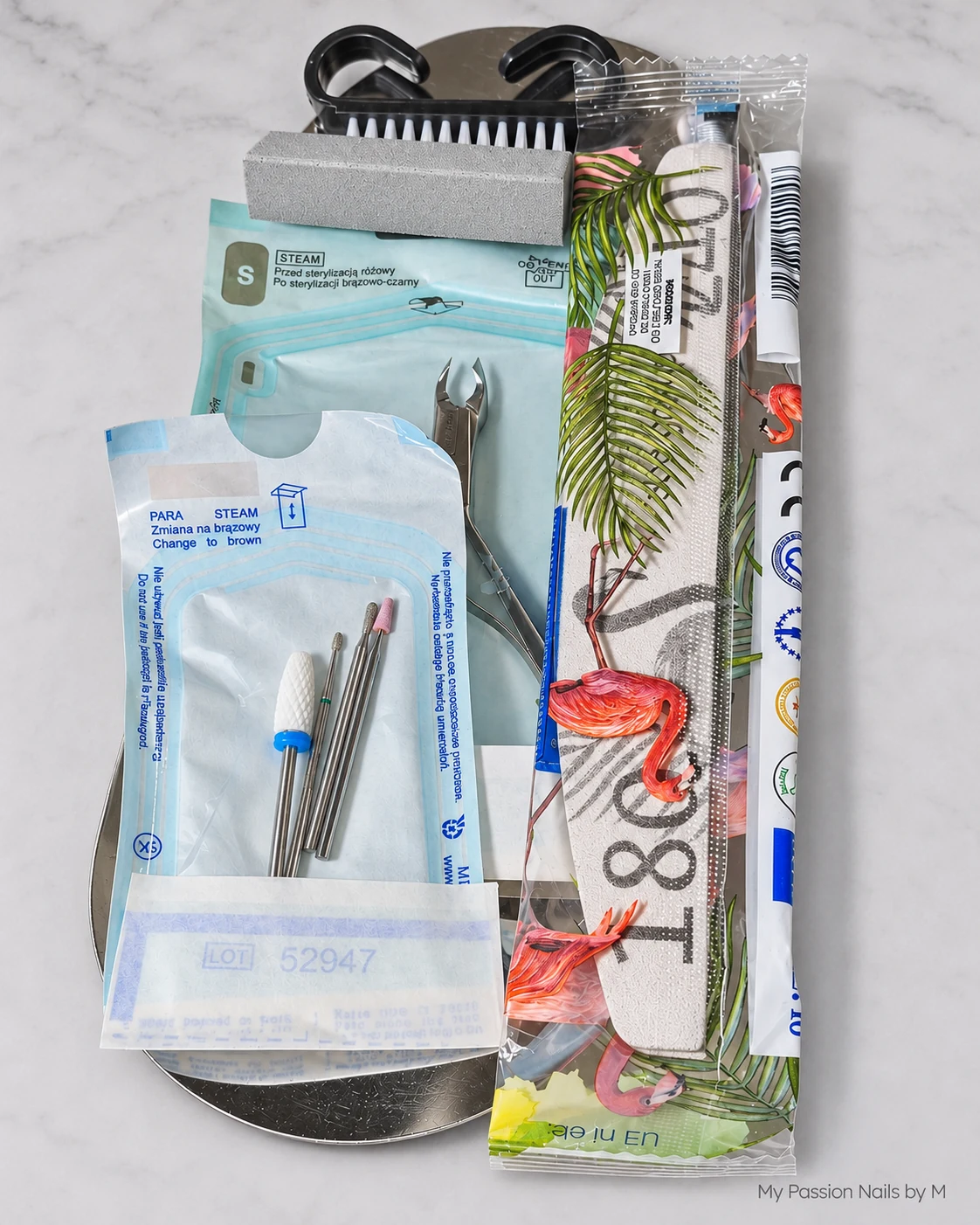
Before every appointment, I prepare a new, single-use file for my client, along with reusable instruments that have been sterilised in an autoclave. Once the treatment is finished, I put the file in the bin. I do not keep it for another appointment, even for the same person.
This is a regular part of my work. For me, caring for your nails starts with preparing the workstation and tools, before the manicure even begins.
When choosing a manicure, we usually focus on colour, shape and how long it lasts. The parts of the work that do not appear in the finished photograph deserve attention too.
A single-use file is not a small detail intended merely to make a good impression. It is one way of limiting the transfer of contaminants between treatments. Caring for nails begins before the first layer of product is applied.