
In this article
- Where does a nail form?
- Why doesn’t a damaged nail plate heal like skin?
- How quickly do fingernails grow?
- How long does a damaged area take to grow out?
- Does damage to the plate mean damage to the matrix?
- Why bother with care if the nail has to grow out anyway?
- How can you notice progress without checking every day?
- When is simply waiting not the best approach?
You apply cuticle oil every day, take more care with your hands and wait for your nails to return to good condition. A week passes, then another, and the damaged area is still visible. Does that mean your care routine is not working?
Not necessarily. Improving hydration and growing out the damaged part of a nail are two different processes. Your hands may look better and feel softer before the change in the nail plate disappears.
In the previous article, I explained why nails can feel soft after product removal. Now let’s look at where new nail plate comes from and why even the most careful routine cannot replace nail growth.
Where does a nail form?
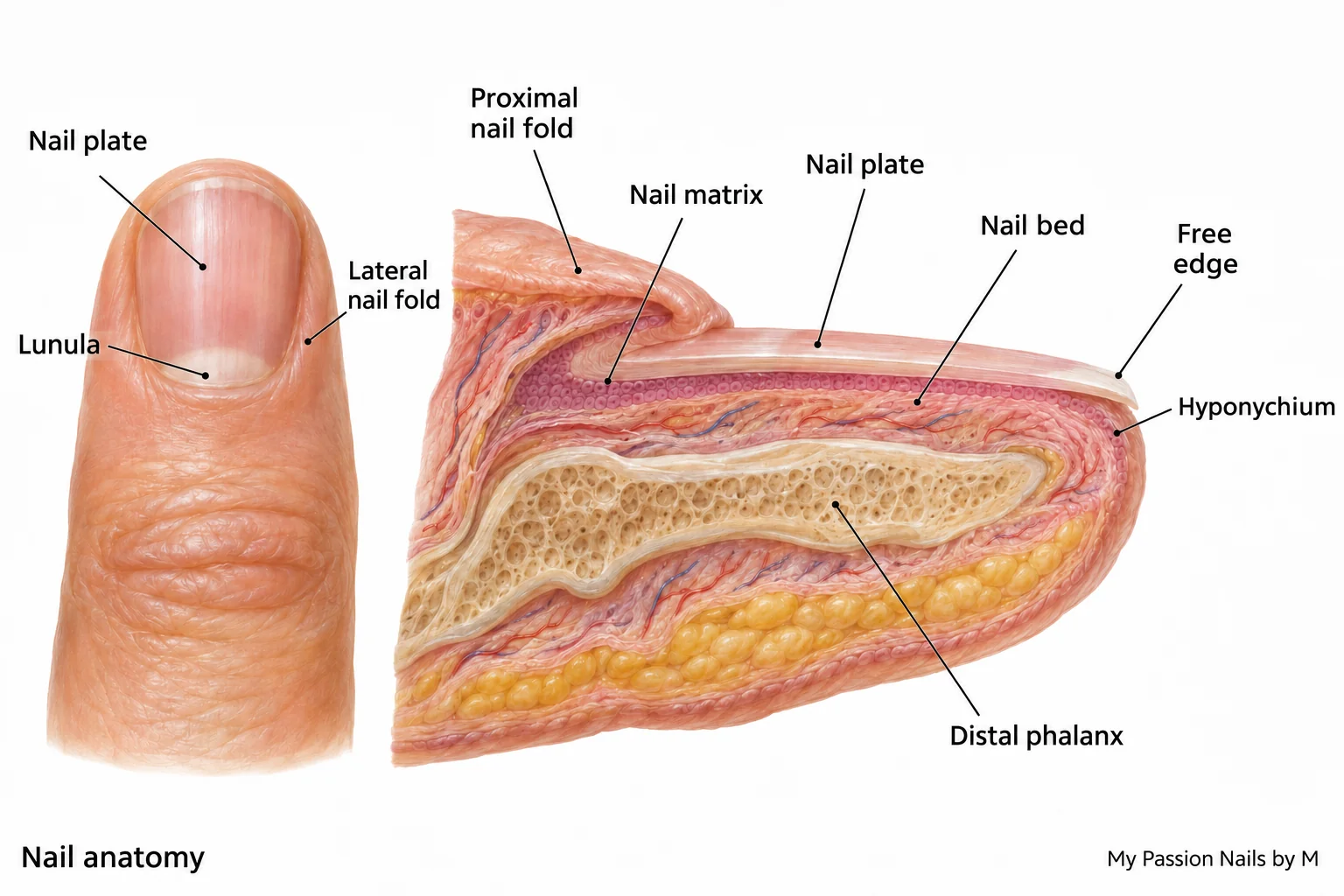
When you look at a nail, what you mainly see is its plate. Yet the area that produces most of it is hidden beneath the skin at the base. This is the nail matrix.
New cells form in the matrix. As they mature, they fill with keratin, flatten and become part of the hard nail plate. The production of more cells gradually pushes the nail towards the fingertip.
A nail therefore does not grow from the tip you shorten with a file. The free edge is the part of the plate that has grown beyond the support of the finger. New nail forms at the base, while the older part gradually moves forward.
This is why a gap appears between your nail coating and the skin after a few weeks of wearing colour. The product stays on the part of the plate where it was applied, while a new section of nail becomes visible at the base.
Why doesn’t a damaged nail plate heal like skin?
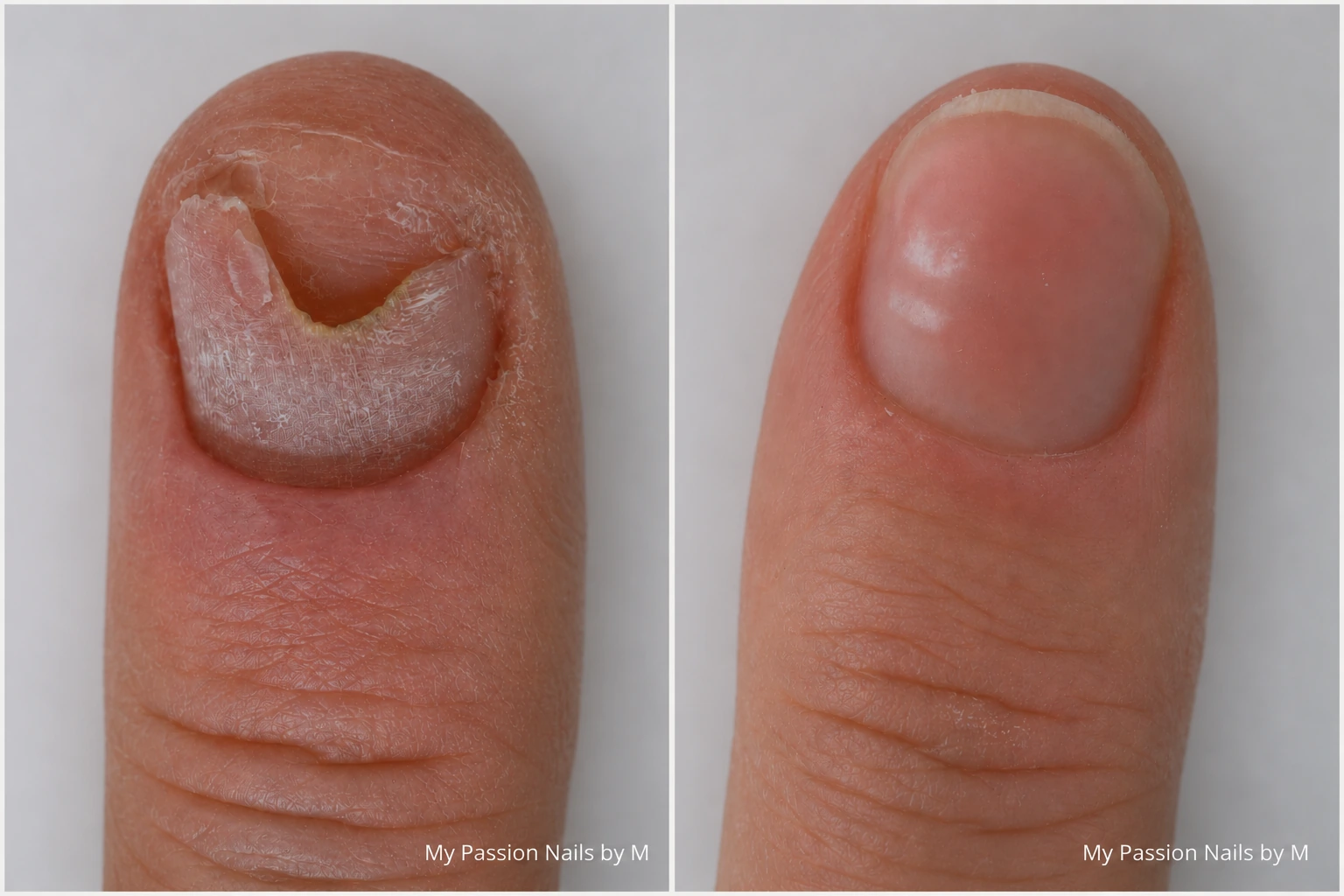
A small scratch can heal because skin is living tissue. The visible nail plate, however, consists of keratinised cells and does not replace missing layers in the same way that skin repairs an injury.
If an area has been overfiled, peeled off with the product or cracked, it will not fill itself in from within. Care can improve its flexibility and limit further damage, but it cannot recreate the lost structure.
It helps to distinguish the plate from the tissues beneath and around it. The nail bed, matrix and skin are living tissues: they can be injured, become painful and need treatment. A more serious nail injury is therefore not just a cosmetic concern.
How quickly do fingernails grow?
A rough guide is about 3 mm per month, but the rate is not the same for every person or every finger.
In a study of 22 healthy young adults, average fingernail growth was 3.47 mm per month. The little fingernails grew more slowly than the others. This finding applies to a particular group; it is not a promise that every nail will grow at exactly that rate (Yaemsiri and colleagues, 2010, “Growth rate of human fingernails and toenails in healthy American young adults” — view the publication).
At around 3 mm per month, a nail grows by less than a millimetre in a week. It is hardly surprising that the difference can be difficult to notice when you look at your hands every day.
How long does a damaged area take to grow out?
Much depends on where the damage is located.
A small area of damage near the tip has less distance to travel before it can safely be trimmed away. A change near the base has to move along almost the entire length of the visible plate.
After a fingernail is lost, complete regrowth usually takes around 4–6 months. That does not mean every small defect will remain visible for that long. On the other hand, after a more serious injury, the growth and appearance of the new plate may differ from before.
This is why saying that “nails regenerate in a week” can be misleading. Within a week, you may notice that your skin looks better or feels less dry, but that is not the same as replacing the damaged plate with a new one.
Does damage to the plate mean damage to the matrix?
No. This is an important distinction.
Superficial damage to the visible plate does not automatically mean that the area producing it has been damaged. If the matrix is functioning normally and the cause of the problem has been removed, the new section may grow without the same changes.
The situation can be different after an injury involving the matrix. Depending on its nature and extent, there may be growth disturbances, grooves or changes in nail shape. Some effects are temporary; others may be permanent. A photograph alone cannot provide a reliable assessment.
This is why not every uneven nail should be filed vigorously to make it smooth. Doing so can remove more layers of the plate without addressing the reason for its appearance.
Why bother with care if the nail has to grow out anyway?
Care is worthwhile because it helps protect what is already there while you wait for the new section to grow.
The aim is not for oil to “produce” the missing nail plate. It is to limit dryness and everyday damage that could make growing the nail out more difficult.
In practice, this brings us back to a few simple principles from the previous article: keeping nails at a sensible length, applying cream regularly, protecting your hands during household tasks and not picking off leftover product. Avoiding another injury is especially important: a shorter nail is less likely to catch on objects or bend sharply.
That is less dramatic than a promise of instant repair, but it better reflects how a natural nail behaves.
How can you notice progress without checking every day?
Instead of examining your nail several times a day, you can take a photograph every two to three weeks, in similar light, from a similar distance and at the same angle.
Comparing these photos can help you see whether the visible change is moving towards the tip and how the new section at the base looks. You do not need to mark the plate or file its surface.
Photos can also help you describe how things have changed during a consultation. They do not replace a medical assessment if the nail hurts or its condition is getting worse.
When is simply waiting not the best approach?
Pain, bleeding, increasing redness, swelling or substantial nail detachment may require medical assessment. After a severe injury, do not assume that waiting for regrowth will be enough. A lack of improvement or a worsening of the damaged area is also a cause for concern.
Your nail technician can notice a change, discuss what it means for further nail treatments and decide not to carry out a service. However, they cannot replace medical diagnosis.
A nail needs time because new plate must gradually replace the old. The role of care is to provide the best possible conditions, rather than to speed up the process at any cost. Sometimes the best sign of progress is not an instantly smooth surface, but an increasingly large section of nail growing normally.